While reading Minow’s text about truth commissions this weekend, I became a little confused when I read the part concerning public testimony of victims’ trauma, and the broadcasting of it to obtain sympathetic witnesses. While Minow argued that through public testimony, victims forged trusting relationships and received acknowledgement and validation from others. I’m a little skeptical as to if this actually works or not.
On one hand it seems like a decent idea, and that victims could actually benefit from this. Having people show their support, and reiterate the fact that people sympathize with them must be a positive part of their progress towards healing. Furthermore, if other victims see these testimonies that are publicized, they may come forward with valuable information, not to mention it may help in their healing as well.
But on the other hand, it seems that this publicity could be detrimental. I feel that instead of helping the victims, it could possibly induce shame with them instead. While some people may be proud of what they had endured, and want to use their voices as a tool, others may be hurt by the constant reminder of their pain. Until a certain point in healing has been reached, it seems that this broadcasting may hold some victims back from healing at a desirable pace.
The problem with this however is that no one will heal at the same pace as another person, and because of such society cannot just halt all things that may get in the way of it. Even though both options – broadcasting the victims’ testimonies or refraining from such – can both cause psychological damage, one must be chosen. While it has damaging properties, I guess in the end I could see more benefits coming from broadcasting the testimonies, but I’m still not comfortable with it.
Sunday, November 29, 2009

Mercy & Justice
For the past couple of weeks, whenever we’ve talked about truth commissions, we’ve discussed the shame culture and its relation to societies where there is a truth commission. We’ve talked about how the two usually aren’t mutually exclusive and how in a society where one exist, the other is sure to exist as well. Numerous times we have stated that you can’t prescribe the shame as a punishment when truth commissions grant amnesty to the perpetrators. However, if shame, defined as a feeling one gets when they have done something they feel guilty about, cannot be prescribed then why can mercy, also a feeling, be included in justice?
In class last Friday, we talked about Kiss’ essay in which she believes that if restorative justice focuses too much on reconciliation and not punishment, it would transcend the dichotomy of punishment and reconciliation and introduce mercy into justice. We went on to say that mercy can suspend laws, but not justice as the empathy associated with mercy coincides with the idea of justice. Although it can be reasonably argued, I’m still having trouble with the fact that something so personal as mercy can be included in a process so public. Yes, shame is more expressed through actions than mercy is, but to me they both are private matters that should remain separate from the process of seeking justice.
In class last Friday, we talked about Kiss’ essay in which she believes that if restorative justice focuses too much on reconciliation and not punishment, it would transcend the dichotomy of punishment and reconciliation and introduce mercy into justice. We went on to say that mercy can suspend laws, but not justice as the empathy associated with mercy coincides with the idea of justice. Although it can be reasonably argued, I’m still having trouble with the fact that something so personal as mercy can be included in a process so public. Yes, shame is more expressed through actions than mercy is, but to me they both are private matters that should remain separate from the process of seeking justice.
A Fairly Digressive Argument for Naming Names
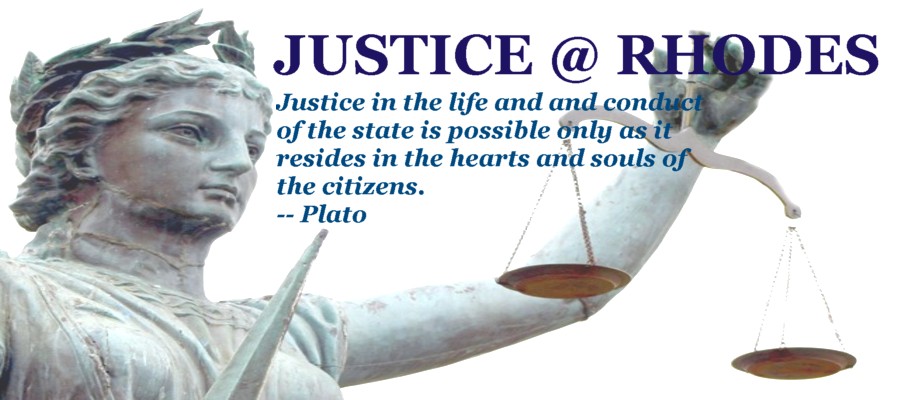
How many of you have read the Plato quotation that heads this blog? I had not really noticed until today when I sat down to write a post about why I think naming names is so important. Aside from the typo (sorry Dr. J), I realized how pregnant the quotation is and just how relevant it is to our discussions of truth commissions and how those discussions have probably colored our ideas on the abstract idea of justice. I'll reproduce the quotation here, just in case that statue distracts you:
"Justice in the life and conduct of the state is possible only as it resides in the hearts and souls of the citizens"
On first reading, there is a pretty explicit argument that, in order to achieve the form of Justice, there is a need for it to somehow be instilled in every heart and soul. Simply put, the form of justice on the state level depends on the presence of justice within every human being contained by the state.
But re-reading the phrase "as it resides" made me wonder a bit. Could that phrase hint at another meaning? Of course, I would say yes. I believe that the phrase could mean that a collective notion of justice already exists inside of everyone. The truth of justice is not something outside of us, something to be searched for beyond us, or even something that an external force necessarily injects into us. Justice, at least so it seems with this reading of the quotation, is not some distant, abstract––objective––notion. If anything, justice lies within each human being. It is, thus, subjective. Or to be more precise, the truth of Justice lies in the inter-subjective notions of justice mixing with each other.
And this is what is so promising about truth commissions, for they are the closest things we have to realizing Justice's very innate intersubjectivity, or as I have called it, the truth of Justice. It is the very act of humans reconciling with other human beings, of hearts and souls actively realizing a notion of justice collectively. And what's more, the truth of Justice is no longer sought in the shadow of some authoritative, arbitrarily prescribed morality, but in exactly the opposite. The truth is constantly being discovered under the light of publicity; humans are reconciling the truth "with other humans" in the truest sense of the prepositional phrase.
But why is publicity necessary? My answer: In what other mode is a truth commission going to be considered as true? Striking names from records seems, to me, to invalidate the "truth"of these commissions. Not only does any form of non-disclosure reek of dishonesty in general, the act contradicts the sense that justice truly "resides in the hearts and souls of the citizens". If we fail to give victims (and perpetrators) a completely honest environment, one in which they are completely free to express their notions of justice, then they both lose some responsibility for reconciling the truth of the matter. Thus, if we support a system in which the full truth is not disclosed to the collective individuals that compose a society, then we contradict our overwhelming sense that the truth of Justice lies in the hearts of every heart and soul. If we truth commissions do not fully disclose the truth, then they become the arbiters of the truth of Justice. And if we allow that to happen, then we have effectively relinquished our own capability to decide what is truly just.
Saturday, November 28, 2009
"Moral Hatred"
After reading the Kiss essay, the concept of “moral hatred” really resonated. Truth commissions are established presumably to “restore” a society, but is that restoration between the perpetrator and society or the perpetrator and the victim? The TRC was structured in a way that seemed to center around the victim. Commissioners listened to the stories of victims without interruption, the assembly rose in a gesture of respect when the victim entered the room, many commissioners offered to participate in prayer and song with the witnesses, and provided crucial social work assistance. Whereas the courtroom establishes a protagonist/antagonist divide, Truth Commissions seem to be about comforting and assisting the victim.
The TRC offered amnesty to perpetrators in exchange for a comprehensive truth of the acts they committed. At times this included detailing the atrocities committed to the spouse, children, or friends of the deceased or disappeared. For many of the victims attaching a face to the perpetrator, could initiate the healing process, but for others it could provide a focal point for their anger. This “moral hatred” would only be compounded by the fact that the victim can no longer seek prosecution of the perpetrator because of the amnesty they received. Kiss noted that in order to accept restorative justice, one must accept the premise that an individual can be transformed after they’ve committed a crime. Even if this is something that happens, I find it difficult to believe that in all cases the perpetrator has a change of heart and truly feels remorse for their actions. This encapsulates many of the criticism that there were Christian undertones in the TRCs organization. If the path to restoring the society is through a change of heart in the perpetrator, can the commissioners truly prescribe that?
Kiss noted that the idea of healing from restorative justice only came about from deliberation by the commissioners when drafting their final report; moreover, a whole only 17% of the South African society believed the TRC promoted reconciliation. Ideally Truth Commissions seek to restore the relationship between the victim and perpetrator, but if the victim does not forgive or if the perpetrator does not feel remorse this is impossible. Moreover, neither of those events can be prescribed, they occur spontaneously. Perhaps the real restorative nature of a Truth Commission is between the victim and the society as well as the perpetrator and society. By providing the victim with a conduit for their suffering, they are able to reintegrate with other human beings who empathize with their condition. For the perpetrators, they receive amnesty but at a cost of shame, shame which ultimately could lead them to feel remorse and undergo a "change of heart." If the ultimate goal is to find the truth that led to a systemic authorization of crimes against humanity and prevent it from happening again, Truth Commissions may be able to find success.
The TRC offered amnesty to perpetrators in exchange for a comprehensive truth of the acts they committed. At times this included detailing the atrocities committed to the spouse, children, or friends of the deceased or disappeared. For many of the victims attaching a face to the perpetrator, could initiate the healing process, but for others it could provide a focal point for their anger. This “moral hatred” would only be compounded by the fact that the victim can no longer seek prosecution of the perpetrator because of the amnesty they received. Kiss noted that in order to accept restorative justice, one must accept the premise that an individual can be transformed after they’ve committed a crime. Even if this is something that happens, I find it difficult to believe that in all cases the perpetrator has a change of heart and truly feels remorse for their actions. This encapsulates many of the criticism that there were Christian undertones in the TRCs organization. If the path to restoring the society is through a change of heart in the perpetrator, can the commissioners truly prescribe that?
Kiss noted that the idea of healing from restorative justice only came about from deliberation by the commissioners when drafting their final report; moreover, a whole only 17% of the South African society believed the TRC promoted reconciliation. Ideally Truth Commissions seek to restore the relationship between the victim and perpetrator, but if the victim does not forgive or if the perpetrator does not feel remorse this is impossible. Moreover, neither of those events can be prescribed, they occur spontaneously. Perhaps the real restorative nature of a Truth Commission is between the victim and the society as well as the perpetrator and society. By providing the victim with a conduit for their suffering, they are able to reintegrate with other human beings who empathize with their condition. For the perpetrators, they receive amnesty but at a cost of shame, shame which ultimately could lead them to feel remorse and undergo a "change of heart." If the ultimate goal is to find the truth that led to a systemic authorization of crimes against humanity and prevent it from happening again, Truth Commissions may be able to find success.
Friday, November 20, 2009
naming names
Going back to the class discussion about whether or not a truth commission should name names, I think that while naming names is an essential part of the process for satisfying the victims' right to the truth, in certain circumstances naming names could be an irresponsible, dangerous, and even perhaps detrimental decision to the goal of restorative justice if the right civil institutions are not yet in place.
For example, I think that without at least a functioning judicial system, and a basic respect for the rule of law that the judiciary is supposed to represent, that naming names would be a dangerous idea both for the victims and the perpetrators. Even if the courts are obviously and horribly biased, so much so that the population has no trust for the rule of law they represent, it is important that through the Commission a country's judicial system is able to regain respect and authority so that their own verdicts and administration of the law are not disregarded. Without this basic respect for rule of law, the prospects of violence erupting after naming names seems great. For example, in Mozambique there was so little countrywide respect for rule of law that if someone testified against another in their village they could expect their house to be killed or for their property to be destroyed. Similarly, the Burundi Commission of Inquiry had trouble even getting people to provide testimony at all since the courts and the Army were filled with people who were responsible for the mass killings that took place in 1993. Naming names, then, would have been suicidal for the victims of the conflict who wished to tell their stories.
On the other hand, naming names in a country lacking respect for the judiciary or without a program to protect the perpetrators of the crimes runs the danger of promoting vigilantism. In South Africa, the truth commission was able to support a witness protection program that protected those who testified against powerful political figures as well as those who admitted to carrying out crimes under the previous regimes. It seems unlikely that anyone would have come forward if testifying only left them open to be killed by an upset witness.
If neither witness protection or respect for rule of law exist then, it seems like naming names would be a very irresponsible way to treat both the victims and the perpetrators of the crimes in question. While it may be impossible to predict the consequences of a decision, the risk of choosing to name names for the sake of truth without first considering the potentially deadly outcomes is reckless. While the truth would be upheld, the cost of the truth in terms of the danger that naming names would put on witness and perpetrators alike in a insecure, lawless, situation, and the cost that the resulting violence would have on the prospects for a society's move towards a peaceful future, would not be worth the risk.
For example, I think that without at least a functioning judicial system, and a basic respect for the rule of law that the judiciary is supposed to represent, that naming names would be a dangerous idea both for the victims and the perpetrators. Even if the courts are obviously and horribly biased, so much so that the population has no trust for the rule of law they represent, it is important that through the Commission a country's judicial system is able to regain respect and authority so that their own verdicts and administration of the law are not disregarded. Without this basic respect for rule of law, the prospects of violence erupting after naming names seems great. For example, in Mozambique there was so little countrywide respect for rule of law that if someone testified against another in their village they could expect their house to be killed or for their property to be destroyed. Similarly, the Burundi Commission of Inquiry had trouble even getting people to provide testimony at all since the courts and the Army were filled with people who were responsible for the mass killings that took place in 1993. Naming names, then, would have been suicidal for the victims of the conflict who wished to tell their stories.
On the other hand, naming names in a country lacking respect for the judiciary or without a program to protect the perpetrators of the crimes runs the danger of promoting vigilantism. In South Africa, the truth commission was able to support a witness protection program that protected those who testified against powerful political figures as well as those who admitted to carrying out crimes under the previous regimes. It seems unlikely that anyone would have come forward if testifying only left them open to be killed by an upset witness.
If neither witness protection or respect for rule of law exist then, it seems like naming names would be a very irresponsible way to treat both the victims and the perpetrators of the crimes in question. While it may be impossible to predict the consequences of a decision, the risk of choosing to name names for the sake of truth without first considering the potentially deadly outcomes is reckless. While the truth would be upheld, the cost of the truth in terms of the danger that naming names would put on witness and perpetrators alike in a insecure, lawless, situation, and the cost that the resulting violence would have on the prospects for a society's move towards a peaceful future, would not be worth the risk.
Monday, November 16, 2009
Nozick Revisted
In our recent discussions about torture and truth commissions, I've been thinking a lot about Nozick's entitlement theory, which states (in my words) that the justness of a system is determined by its agreeableness to the entitlement of everyone involved in the system. Basically, as long as everyone agrees that a certain system is justly changed, the system becomes just.
But what are we to do with something so thorny as the institution of torture? To me, there is a humongous difference between parties agreeing to certain entitlements and people "consenting" to be tortured. Wasn't it Locke who said that no one can consign away their basic rights?
But if this is the case, why does torture persist? I don't think Nozick can answer this question. Or at least I think he would perpetually waffle with it. It's hard, in my mind, to think that someone can sign away the basic entitlement to their own humanity (keep in mind that I write this under the basic assumption that we discussed in class, namely, that torture is necessarily the act of dehumanizing someone).
But then what gets me even more is the sense that, under Nozick's theory of justice, the fact that this torture inclusive system is around today proves its justness. That, to me, sounds utterly ridiculous. Living in a world where consent is mandated by physical coercion sounds like justice itself is being tortured...
But what are we to do with something so thorny as the institution of torture? To me, there is a humongous difference between parties agreeing to certain entitlements and people "consenting" to be tortured. Wasn't it Locke who said that no one can consign away their basic rights?
But if this is the case, why does torture persist? I don't think Nozick can answer this question. Or at least I think he would perpetually waffle with it. It's hard, in my mind, to think that someone can sign away the basic entitlement to their own humanity (keep in mind that I write this under the basic assumption that we discussed in class, namely, that torture is necessarily the act of dehumanizing someone).
But then what gets me even more is the sense that, under Nozick's theory of justice, the fact that this torture inclusive system is around today proves its justness. That, to me, sounds utterly ridiculous. Living in a world where consent is mandated by physical coercion sounds like justice itself is being tortured...
Sunday, November 15, 2009
In Search of "Truth"
So I am very intrigued by this idea of Truth Commissions, the reason behind why they are instituted in particular situations, and what their ultimate goal is: THE TRUTH, or so we all seem to agree. But before I mention more about this, I'd like to start at the beginning.
Torture, war, genocide, hatred, mutilation: all of these things have been happening since the beginning of mankind. Hey, weren't Cain and Abel 2nd generation? And already they wanted to kill each other off and take what wasn't theirs? I'm not really super religious, but I'm intrigued also by the idea of religion... but that's a different story. Anyways-- back to the point. Death and murder exist wherever humans are, or so it appears.
So my first question when I'm sitting in class, thinking about human rights and such: If human rights are so inalienable, how come they haven't been respected until modern times? Is this because back in the day, like the Inquisition or the Crusades (I don't know why all my examples are religious, but just try to follow along), humans just couldn't physically understand that all humans might be the same, want the same things, be hurt in the same way? Obviously the learned philosophers were thinking about these things, but does society need to have plentiful leisure time and mass higher-education systems and the internet to get to the point where we can respect the human rights of everyone, including criminals? Are humans innately selfish creatures who see different skin colors as the opportunity to oppress and exploit? As much as I'd love to say that every one of my ancestors had great bones in their body and believed in peace and harmony-- I'm from New Orleans, Memphis, France, England, and who knows where before then. They were slave-holders, cotton-growers, revolutionaries, heretics, and who knows what else. I guess I'm just curious: if we are trying to protect the rights of someone who has killed someone or initiated a genocide, why now? I doubt anyone would have had a problem if we had gotten to Hitler before he got to himself. What makes today so different that suddenly all humans have the right to defend themselves, even if they've made the active effort to extinguish babies or fly planes into the twin towers? I'm not trying to sound pessimistic here (not the way to spell that word I don't think), but I'm really curious why, to me, this seems like a much more recent phenomenon.
Second question: Genocide. What exactly makes genocide "worse" than, say, war of any kind? Is killing the innocent just because of a grudge against their race really worse than starving and murdering millions of Russians? Okay, I used the word "worse" even though I know I shouldn't have... but I'm not trying to say that one is "worse" than something else, I guess I just don't understand how genocide, in particular, is different than any war in history despite the fact that it was purely civilians and purely for the point of extinguishing race.
A last point that I'd like to make is that I have no idea, YET, where I stand on Truth Commissions. (Hopefully I'll figure this out before the paper...) But I find the 4-tiered truth-defining system to be quite intriguing. I think that truth is always objective, and that there are different levels of truth in any and all situations. I think that defining types of truth in specific terms and utilizing a system like that when attempting to get the truth is a step in the right direction, and that the idea of resorative justice is so cool. I'm going to think a little more on this though, and get back to you.
Torture, war, genocide, hatred, mutilation: all of these things have been happening since the beginning of mankind. Hey, weren't Cain and Abel 2nd generation? And already they wanted to kill each other off and take what wasn't theirs? I'm not really super religious, but I'm intrigued also by the idea of religion... but that's a different story. Anyways-- back to the point. Death and murder exist wherever humans are, or so it appears.
So my first question when I'm sitting in class, thinking about human rights and such: If human rights are so inalienable, how come they haven't been respected until modern times? Is this because back in the day, like the Inquisition or the Crusades (I don't know why all my examples are religious, but just try to follow along), humans just couldn't physically understand that all humans might be the same, want the same things, be hurt in the same way? Obviously the learned philosophers were thinking about these things, but does society need to have plentiful leisure time and mass higher-education systems and the internet to get to the point where we can respect the human rights of everyone, including criminals? Are humans innately selfish creatures who see different skin colors as the opportunity to oppress and exploit? As much as I'd love to say that every one of my ancestors had great bones in their body and believed in peace and harmony-- I'm from New Orleans, Memphis, France, England, and who knows where before then. They were slave-holders, cotton-growers, revolutionaries, heretics, and who knows what else. I guess I'm just curious: if we are trying to protect the rights of someone who has killed someone or initiated a genocide, why now? I doubt anyone would have had a problem if we had gotten to Hitler before he got to himself. What makes today so different that suddenly all humans have the right to defend themselves, even if they've made the active effort to extinguish babies or fly planes into the twin towers? I'm not trying to sound pessimistic here (not the way to spell that word I don't think), but I'm really curious why, to me, this seems like a much more recent phenomenon.
Second question: Genocide. What exactly makes genocide "worse" than, say, war of any kind? Is killing the innocent just because of a grudge against their race really worse than starving and murdering millions of Russians? Okay, I used the word "worse" even though I know I shouldn't have... but I'm not trying to say that one is "worse" than something else, I guess I just don't understand how genocide, in particular, is different than any war in history despite the fact that it was purely civilians and purely for the point of extinguishing race.
A last point that I'd like to make is that I have no idea, YET, where I stand on Truth Commissions. (Hopefully I'll figure this out before the paper...) But I find the 4-tiered truth-defining system to be quite intriguing. I think that truth is always objective, and that there are different levels of truth in any and all situations. I think that defining types of truth in specific terms and utilizing a system like that when attempting to get the truth is a step in the right direction, and that the idea of resorative justice is so cool. I'm going to think a little more on this though, and get back to you.
Torture Talk
The moral issues surrounding torture are a source of great interest for me. There are many reasons for this. I find pain and suffering to be very fascinating, and the way in which these two things interact with the human body and mind is connected to my thought process surrounding torture. I do not believe that the use of torture for interrogative or punitive purpose can ever be legally executed, but I am still unable to honestly say that I believe that using torture is morally wrong in all circumstances.
There are multiple reasons why torture should not or could not be legalized. One reason for this, and possibly the most pertinent, is that studies conclusively show that torture is not an effective means of interrogation. Considering interrogative torture is a major issue within the United States today, it is important that we realize that it is a technique that is not effective.
That being said, torture has caused human beings to give up information in the past. This causes a problem because now there exists a possibility, while small, that torture could cause an individual to share valuable information. For example, let’s imagine that an individual has kidnapped a young girl. Law enforcement apprehends the individual, but he refuses to tell where he is keeping her. Chances are that he will not tell where she is if tortured. But, the possibility remains that if all other interrogation means are exhausted, torture COULD cause him to give up where she is. While I know this might sound simple-minded, I am completely comfortable with using torture in this situation. This being has taken an innocent life into his hands and is willing to let her disappear from the earth, while we refuse to inflict physical pain upon him when the possibility exists that it may work.
I am saying that I am comfortable with torture in this situation, but because of the infinite scenarios and definitions of torture, I see the impossibility of legalizing such and act.
Torture as punishment is another issue that I cannot honestly come to a conclusion on. While the idea of punishment through torture seems like an appealing and useful tool at first in my mind, I do understand and fret over the fact that I do not want a government that disciplines through fear.
But in my mind, there still exists a problem. I understand that the criminals that would be subject to torture as punishment are products of their environment. But every human being is a product of their environment. This does not justify their action! If an individual was abused as a child, an “as a result” murders another human being, where do we stand? Who are we to say that some individuals need physical pain, or at least the possibility of physical pain, as a punishment in order for them to not commit a crime.
Basically, I do not really see a lot of hope. I do not see a society where there are no crimes ever existing. Therefore, there needs to exist some way to correct this problem, and I see no solution that could actually be enacted. The floor is open, if you have any ideas. Eye for an eye, education, torture, the current system, or some brilliant new correctional scheme, you pick.
There are multiple reasons why torture should not or could not be legalized. One reason for this, and possibly the most pertinent, is that studies conclusively show that torture is not an effective means of interrogation. Considering interrogative torture is a major issue within the United States today, it is important that we realize that it is a technique that is not effective.
That being said, torture has caused human beings to give up information in the past. This causes a problem because now there exists a possibility, while small, that torture could cause an individual to share valuable information. For example, let’s imagine that an individual has kidnapped a young girl. Law enforcement apprehends the individual, but he refuses to tell where he is keeping her. Chances are that he will not tell where she is if tortured. But, the possibility remains that if all other interrogation means are exhausted, torture COULD cause him to give up where she is. While I know this might sound simple-minded, I am completely comfortable with using torture in this situation. This being has taken an innocent life into his hands and is willing to let her disappear from the earth, while we refuse to inflict physical pain upon him when the possibility exists that it may work.
I am saying that I am comfortable with torture in this situation, but because of the infinite scenarios and definitions of torture, I see the impossibility of legalizing such and act.
Torture as punishment is another issue that I cannot honestly come to a conclusion on. While the idea of punishment through torture seems like an appealing and useful tool at first in my mind, I do understand and fret over the fact that I do not want a government that disciplines through fear.
But in my mind, there still exists a problem. I understand that the criminals that would be subject to torture as punishment are products of their environment. But every human being is a product of their environment. This does not justify their action! If an individual was abused as a child, an “as a result” murders another human being, where do we stand? Who are we to say that some individuals need physical pain, or at least the possibility of physical pain, as a punishment in order for them to not commit a crime.
Basically, I do not really see a lot of hope. I do not see a society where there are no crimes ever existing. Therefore, there needs to exist some way to correct this problem, and I see no solution that could actually be enacted. The floor is open, if you have any ideas. Eye for an eye, education, torture, the current system, or some brilliant new correctional scheme, you pick.
Justice in the Courtroom
Since Eric Holder announced on Friday that Khalid Sheikh Mohammed and several other terrorists would be brought to trial in the Manhattan federal courthouse, there has been no shortage of media sparring over the pros and cons of this decision. Of course much of the discussion has centered around the justification of such a move by the Obama administration, but with our recent discussion of the various 'layers' of truth that often times unfold out of incomprehensible tragedies, I wonder if a court of justice really is the most appropriate venue for this matter.
Obviously, based on the principals that establish our government, a trial in the civil courts is the surest way our government can attempt to seek out a bit of justice for the horrible events that happened on September 11th. This certainly seems to be the moral high ground as far as justice by our laws is concerned. However, it is highly unfortunate that this sort of trial will most assuredly become a media circus of never before seen proportions. This point has been raised repeatedly over the weekend news cycle because as many of the pundits have rightly assumed, a huge spectacle is probably just what someone like Khalid Sheikh Mohammed would prefer.
But in light of our classroom discussions I think the most pertinent question to ask is whether or not our civil court system can appropriately work through this trial without making a mockery of the process. Because if a fair trial is set in motion, it will be a dream case for those providing the defense. Since the courthouse is literally blocks away from the place where the World Trade Center once stood, what competent defense attorney wouldn't file for a change of venue? Or better yet have a large portion of the evidence thrown out for a litany of reasons - torture, chain of evidence custody, or improper discovery due to national security issues.
At best we can hope that the trials will be executed with as few disturbances as possible, but I think there is little doubt that a savvy defense attorney could give his or her clients a propaganda tool of very dangerous proportions. But we can look to the trial of Omar Abdel Rahman for some solace. He was the blind sheik that was tried in a civil court for his role in the 1993 World Trade Center bombings. And that trial went forward without making a mockery of the court system. But there is no doubt that the tragedy that brought to U.S. soil on September 11 was much much worse than any other act of terrorism ever conceived. And the subsequent capture and treatment of men like Khalid Sheikh Mohammed will certainly make these upcoming cases arguably some of the most complex judicial proceedings that our court system has ever faced.
Obviously, based on the principals that establish our government, a trial in the civil courts is the surest way our government can attempt to seek out a bit of justice for the horrible events that happened on September 11th. This certainly seems to be the moral high ground as far as justice by our laws is concerned. However, it is highly unfortunate that this sort of trial will most assuredly become a media circus of never before seen proportions. This point has been raised repeatedly over the weekend news cycle because as many of the pundits have rightly assumed, a huge spectacle is probably just what someone like Khalid Sheikh Mohammed would prefer.
But in light of our classroom discussions I think the most pertinent question to ask is whether or not our civil court system can appropriately work through this trial without making a mockery of the process. Because if a fair trial is set in motion, it will be a dream case for those providing the defense. Since the courthouse is literally blocks away from the place where the World Trade Center once stood, what competent defense attorney wouldn't file for a change of venue? Or better yet have a large portion of the evidence thrown out for a litany of reasons - torture, chain of evidence custody, or improper discovery due to national security issues.
At best we can hope that the trials will be executed with as few disturbances as possible, but I think there is little doubt that a savvy defense attorney could give his or her clients a propaganda tool of very dangerous proportions. But we can look to the trial of Omar Abdel Rahman for some solace. He was the blind sheik that was tried in a civil court for his role in the 1993 World Trade Center bombings. And that trial went forward without making a mockery of the court system. But there is no doubt that the tragedy that brought to U.S. soil on September 11 was much much worse than any other act of terrorism ever conceived. And the subsequent capture and treatment of men like Khalid Sheikh Mohammed will certainly make these upcoming cases arguably some of the most complex judicial proceedings that our court system has ever faced.
The four types of truth
In class Friday we discussed the four types of truth (forensic, narrative, social, and restorative), and I had never really thought about the different categories of information that went into the idea of “truth.” For myself, when the idea of “truth” comes to mind, I most readily think of forensic and social truth. Forensic, because we put so much into the hard facts, and what can be implicitly known about a case. Social, because I think the way in which the community responds to a case or such is what is most widely known, I suppose. But I was highly intrigued in the ideas of narrative and restorative truth.
Restorative truth seems to be a simple and reasonable part, and is something that I think gets overlooked in so many cases. It seems that society cares about what needs to be done in order to re-humanize victims and the rest of the affected, but I feel like this is so easily thrown to the wayside. It seems that people are more interested in the perpetrator “getting what they deserve” more so than fixing the issues that have arisen for those who were directly affected by the act and violator. This in itself weighed heavily on me. While I think it is important for those who committed a crime to be rightly convicted, I think the majority of society’s concerns should be with those who were harmed. We should care more about helping them recover, and how they feel than what punishment the criminal obtains. I admit that it is important for the criminal to face the consequences of his or her actions, so that they may not repeat their actions on others, I do not understand why the well being of the victim(s) can get pushed aside so readily.
Looking at narrative truth, I was a little bit confused about the concept of having two sides of a story that are unable to coincide, but are both completely true. How is this able to be used for justice? If there are conflicting sides, where does the resolution come about, and how? When you have the truth as two different people see it, and they don’t line up, isn’t it the reaction of most people that one side be true and the other false? How do prosecutors determine what can be trusted and what cannot?
Restorative truth seems to be a simple and reasonable part, and is something that I think gets overlooked in so many cases. It seems that society cares about what needs to be done in order to re-humanize victims and the rest of the affected, but I feel like this is so easily thrown to the wayside. It seems that people are more interested in the perpetrator “getting what they deserve” more so than fixing the issues that have arisen for those who were directly affected by the act and violator. This in itself weighed heavily on me. While I think it is important for those who committed a crime to be rightly convicted, I think the majority of society’s concerns should be with those who were harmed. We should care more about helping them recover, and how they feel than what punishment the criminal obtains. I admit that it is important for the criminal to face the consequences of his or her actions, so that they may not repeat their actions on others, I do not understand why the well being of the victim(s) can get pushed aside so readily.
Looking at narrative truth, I was a little bit confused about the concept of having two sides of a story that are unable to coincide, but are both completely true. How is this able to be used for justice? If there are conflicting sides, where does the resolution come about, and how? When you have the truth as two different people see it, and they don’t line up, isn’t it the reaction of most people that one side be true and the other false? How do prosecutors determine what can be trusted and what cannot?
The Guns of the South by Harry Turtledove
http://en.wikipedia.org/wiki/The_Guns_of_the_South#Awards
This book rocks, and it seems somewhat relevant to a lot of the stuff we're talking about (in an historical fiction kind of way). It takes place during the Civil War, and these people show up and start giving AK-47's to the South in an attempt to make sure they win. As it progresses, it is revealed that these mysterious people are actually time travelers from 21st century South Africa, and they've come back to rewrite history in favor of whites over blacks. These time travelers buy plantations and slaves and some of the whites in the South begin to question things because they see how poorly they're treating their slaves (aka torture.) Spoiler alert! The story ends up with the South abolishing slavery despite all of these time travelers and their technology and intelligence supporting slavery, and so the story ends on a surprisingly happy note.
This book rocks, and it seems somewhat relevant to a lot of the stuff we're talking about (in an historical fiction kind of way). It takes place during the Civil War, and these people show up and start giving AK-47's to the South in an attempt to make sure they win. As it progresses, it is revealed that these mysterious people are actually time travelers from 21st century South Africa, and they've come back to rewrite history in favor of whites over blacks. These time travelers buy plantations and slaves and some of the whites in the South begin to question things because they see how poorly they're treating their slaves (aka torture.) Spoiler alert! The story ends up with the South abolishing slavery despite all of these time travelers and their technology and intelligence supporting slavery, and so the story ends on a surprisingly happy note.
soldiers' abuses and societal accountability
One of the main moral critiques that has been brought up about torture is the dehumanizing effect it has on the victim as well as on the torturer. Torture purposively treats human beings as if they are not human beings, and in doing so disregards the fundamental human dignity implied in any recognition of universal human rights. If dehumanization is at its core a violation of human rights though, it seems like torture is just one of many actions that accomplish this, while the scope of responsibility for these actions should be examined as well.
The military seems to have an ever increasing list of abuses that fit the description of disrespecting the human dignity of other human beings. At the same time, though, it is important to consider where the responsibility for these abuses rest, and how far back it goes. For example, in having a standing, professional military we as a society at least tacitly accept the fact that there are citizens in our country who we pay to kill other human beings. Furthermore, after training and equipping this military, these soldiers are sent out protect the interests of the U.S. by sending them into situations and conditions where they may come to disregard the basic human dignity and well-being of others with whom they interact. When soldiers do snap, mistreating, torturing, or killing the innocent populations that they are among, it is often portrayed as the isolated and abusive tendencies of specific individuals. We want to punish these individuals for what they have done to innocent human beings, acting as if they were individually responsible. After allowing, and in some cases even demanding, soldiers’ involvement in the necessarily dehumanizing conditions of war, though, it seems a shallow appreciation of responsibility to argue that those soldiers who disregard the human dignity of others are the sole persons at fault. Taking this stance disregards the fact that it is in part the fault of society for putting them in these situations, and consequently perhaps part the fault of society for choosing to subject its own citizens to conditions where their appreciation of human dignity has been so worn down as to allow dehumanizing crimes at their hands to happen in the first place.
As a result, after seeing pictures of prisoner abuse at Abu Ghraib, reading accounts of soldiers throwing frozen water bottles at children, or hearing about the illegal detentions and illegal killings of innocent civilians, one response should be sorrow for the people who have been harmed in this way by soldiers, another should be sadness or anger that U.S. soldiers could treat other humans in these ways, while still another should be pity and guilt that the soldiers have been trained in such as way, and put in such conditions, that these types of actions would even be considered possible. They not only deal out dehumanizing actions by disrespecting the dignity of other human beings, but also have been put into situations where they have themselves suffered dehumanization, put into states lacking the characteristic empathy and respect for others that we consider normal. While they may be individually responsible for their actions, it should be a disconcerting question for the rest of the civilian population as to what extent soldiers have been conditioned to conduct these abuses due to the conditions they have been required to live and fight in.
We train and pay our military to kill other people, an action that is certain to have dehumanizing effects both in the way that soldiers treat their opponents, in the way that soldiers see themselves, and their ability to reintegrate into society upon returning. Just blaming soldiers for their abuses, seems to be a serious throwing off of societal responsibility, as it does not recognize the fact that we as a society are responsible for the decision to train fellow citizens to fight in wars that are dehumanizing, and that might lead normal citizens and human beings to treat others in morally unjustifiable ways. While we should feel sorrow for the abused, I think that sorrow should also be felt for the abusers when it is in part the responsibility of society for placing them in situations that numb their respect for human dignity and allow for abuses to happen in the first place. The extent to which that society labels the atrocities committed at soldiers hands as merely the fault of individuals and not as perhaps indicative of larger problems with the dehumanizing nature of the conflicts or of their training, is the extent to which society rejects the responsibility it has to respect the basic human dignity of its own citizens and soldiers.
The military seems to have an ever increasing list of abuses that fit the description of disrespecting the human dignity of other human beings. At the same time, though, it is important to consider where the responsibility for these abuses rest, and how far back it goes. For example, in having a standing, professional military we as a society at least tacitly accept the fact that there are citizens in our country who we pay to kill other human beings. Furthermore, after training and equipping this military, these soldiers are sent out protect the interests of the U.S. by sending them into situations and conditions where they may come to disregard the basic human dignity and well-being of others with whom they interact. When soldiers do snap, mistreating, torturing, or killing the innocent populations that they are among, it is often portrayed as the isolated and abusive tendencies of specific individuals. We want to punish these individuals for what they have done to innocent human beings, acting as if they were individually responsible. After allowing, and in some cases even demanding, soldiers’ involvement in the necessarily dehumanizing conditions of war, though, it seems a shallow appreciation of responsibility to argue that those soldiers who disregard the human dignity of others are the sole persons at fault. Taking this stance disregards the fact that it is in part the fault of society for putting them in these situations, and consequently perhaps part the fault of society for choosing to subject its own citizens to conditions where their appreciation of human dignity has been so worn down as to allow dehumanizing crimes at their hands to happen in the first place.
As a result, after seeing pictures of prisoner abuse at Abu Ghraib, reading accounts of soldiers throwing frozen water bottles at children, or hearing about the illegal detentions and illegal killings of innocent civilians, one response should be sorrow for the people who have been harmed in this way by soldiers, another should be sadness or anger that U.S. soldiers could treat other humans in these ways, while still another should be pity and guilt that the soldiers have been trained in such as way, and put in such conditions, that these types of actions would even be considered possible. They not only deal out dehumanizing actions by disrespecting the dignity of other human beings, but also have been put into situations where they have themselves suffered dehumanization, put into states lacking the characteristic empathy and respect for others that we consider normal. While they may be individually responsible for their actions, it should be a disconcerting question for the rest of the civilian population as to what extent soldiers have been conditioned to conduct these abuses due to the conditions they have been required to live and fight in.
We train and pay our military to kill other people, an action that is certain to have dehumanizing effects both in the way that soldiers treat their opponents, in the way that soldiers see themselves, and their ability to reintegrate into society upon returning. Just blaming soldiers for their abuses, seems to be a serious throwing off of societal responsibility, as it does not recognize the fact that we as a society are responsible for the decision to train fellow citizens to fight in wars that are dehumanizing, and that might lead normal citizens and human beings to treat others in morally unjustifiable ways. While we should feel sorrow for the abused, I think that sorrow should also be felt for the abusers when it is in part the responsibility of society for placing them in situations that numb their respect for human dignity and allow for abuses to happen in the first place. The extent to which that society labels the atrocities committed at soldiers hands as merely the fault of individuals and not as perhaps indicative of larger problems with the dehumanizing nature of the conflicts or of their training, is the extent to which society rejects the responsibility it has to respect the basic human dignity of its own citizens and soldiers.
In the News
Guantanamo Bay is in the news again, for two different reasons. Firstly, I saw this story: http://www.kcbs.com/pages/5669356.php? on the CBS Evening News on Friday. The big story is that the U.S. government has chosen to hold trials for “9/11 mastermind” Khalid Sheikh Mohammed and four other terrorists associated with the September 11 World Trade Center attacks in New York City just blocks from the former site of the two towers, instead of trying them in a military court.
Of course there are many people against this decision citing issues of national security, but some objections are not so much out of concern for the safety of American citizens but for the protection of government procedures employed while the men were detained in Gitmo. The article does not identify who has voiced these concerns, but it does state that trial in a civilian court may force the court to deal with issues surrounding “interrogation techniques” used on the prisoners including waterboarding, which was used on Khalid Sheikh Mohammed a total of 183 times. Is this a legitimate concern? What I mean by that is, does the U.S. government, by trying these terrorists in a civilian court, run the risk of exposing itself and its controversial practices? Could this possibly lead to somehow putting torture on trial, and a reinvigoration of anti-torture lobbying?
In a similar vein, the article quotes some civilians who lost loved ones on 9/11/2001 who are against a civilian trial because the defense attorneys could make their clients out to be “victims” of our system and induce sympathy for the terrorists. Personally, I don’t think any jury of American citizens would sympathize with the orchestrators of the 9/11 attacks, so this concern is moot. But, considering our discussions in class these past two weeks, should we consider the terrorists who have possibly experienced the worst forms of torture over the course of the past few years “victims” of the American system?
Secondly, this issue has come to light today: http://www.cnn.com/2009/US/11/15/illinois.next.gitmo/index.html and as I type this, I am watching this story further unfold on CNN. A mostly empty maximum security prison in Illinois, Thomson Correctional Center, has been identified as the most likely new home for current detainees in Guantanamo Bay. While I think the main issue discussed here is the ramifications that housing the prisoners there would have for the city of Chicago and the state of Illinois, I think the big picture is more important.
President Obama has pledged for a while now that he would close Guantanamo Bay; the deadline was originally set for January 22, 2010, but it has been suspected for a while now that the deadline would not be met. I think this initiative, to locate an adequate alternative facility for Gitmo’s current prisoners, is a step in the right direction, and it also assuages the doubt that the Obama administration is actually working to achieve its stated goal. While there is no guarantee that abhorrent practices such as torture will cease once the detainees are relocated, there is hope that our government is working to right the inadmissible wrongs committed in the name of national security.
Truth Commissions and Determinism
It seems the arguments in favor of torture have all been exhausted and shown as not only immoral, but impractical. The new arguments concern truth commissions and their validity and practicality. Do truth commissions bring about justice for crimes against humanity? Is amnesty in exchange for truth worth letting the criminal go?
In class, there have been several allusions to studies showing that amnesty helps the victims of the crime more than simply punishing the criminal. I’ve never read these studies, but am willing to take Dr. Johnson’s word for it. What interests me about the argument for truth rather than punishment is how it works into determinism. If determinism is granted as true, then there can be no culpability, and thus no moral grounds on which to blame the criminals. Punishment under determinism is ungrounded, so it seems like gaining the truth in order to help the victims is obviously a better option. The criminal is not punished for something that was going to happen anyway, and those affected by the crime will supposedly be better off.
Trying to fit justice into determinism is very difficult, but in the case of truth commissions, it seems to fit quite nicely at times. When considering egregious crimes against humanity, it is hard to settle on what the best punishment or retribution for the crime should be. The people affected should be compensated for their loss somehow, and it should also be demonstrated that we, as humans, will not accept the occurrence of these crimes. It makes sense to allow for the criminals to gain amnesty for the truth if that is what brings about the best for the victims and for world knowledge. In a sense, this is a utilitarian idea, for it brings about the most pleasure for the most people. This can also work with determinism because we are declaring that these actions are indeed wrong, but not enforcing culpability onto the individual. Obviously, truth commissions do hold those that committed the crimes responsible for their actions, but by granting amnesty they do not act on this culpability.
I realize when writing this that I’m using moral grounds to defend amnesty in exchange for truth, all the while, toting determinism, but in the scope of this argument I believe it is acceptable. I am merely trying to argue that certain aspects of truth commissions can be accepted by determinism.
In class, there have been several allusions to studies showing that amnesty helps the victims of the crime more than simply punishing the criminal. I’ve never read these studies, but am willing to take Dr. Johnson’s word for it. What interests me about the argument for truth rather than punishment is how it works into determinism. If determinism is granted as true, then there can be no culpability, and thus no moral grounds on which to blame the criminals. Punishment under determinism is ungrounded, so it seems like gaining the truth in order to help the victims is obviously a better option. The criminal is not punished for something that was going to happen anyway, and those affected by the crime will supposedly be better off.
Trying to fit justice into determinism is very difficult, but in the case of truth commissions, it seems to fit quite nicely at times. When considering egregious crimes against humanity, it is hard to settle on what the best punishment or retribution for the crime should be. The people affected should be compensated for their loss somehow, and it should also be demonstrated that we, as humans, will not accept the occurrence of these crimes. It makes sense to allow for the criminals to gain amnesty for the truth if that is what brings about the best for the victims and for world knowledge. In a sense, this is a utilitarian idea, for it brings about the most pleasure for the most people. This can also work with determinism because we are declaring that these actions are indeed wrong, but not enforcing culpability onto the individual. Obviously, truth commissions do hold those that committed the crimes responsible for their actions, but by granting amnesty they do not act on this culpability.
I realize when writing this that I’m using moral grounds to defend amnesty in exchange for truth, all the while, toting determinism, but in the scope of this argument I believe it is acceptable. I am merely trying to argue that certain aspects of truth commissions can be accepted by determinism.
Subscribe to:
Posts (Atom)
